Materials for your 3D print
Yannic Fréson 3D, a 3D printing service for the Heist-op-den-Berg area in Belgium, prints in four plastics: PLA in matte, silk and wood-filled, PETG, ABS and ASA. PLA is stocked in thirteen colours and suits most indoor prints. PETG is tougher and copes with moisture, ABS with heat, ASA with sun and rain. Those three are ordered on request.
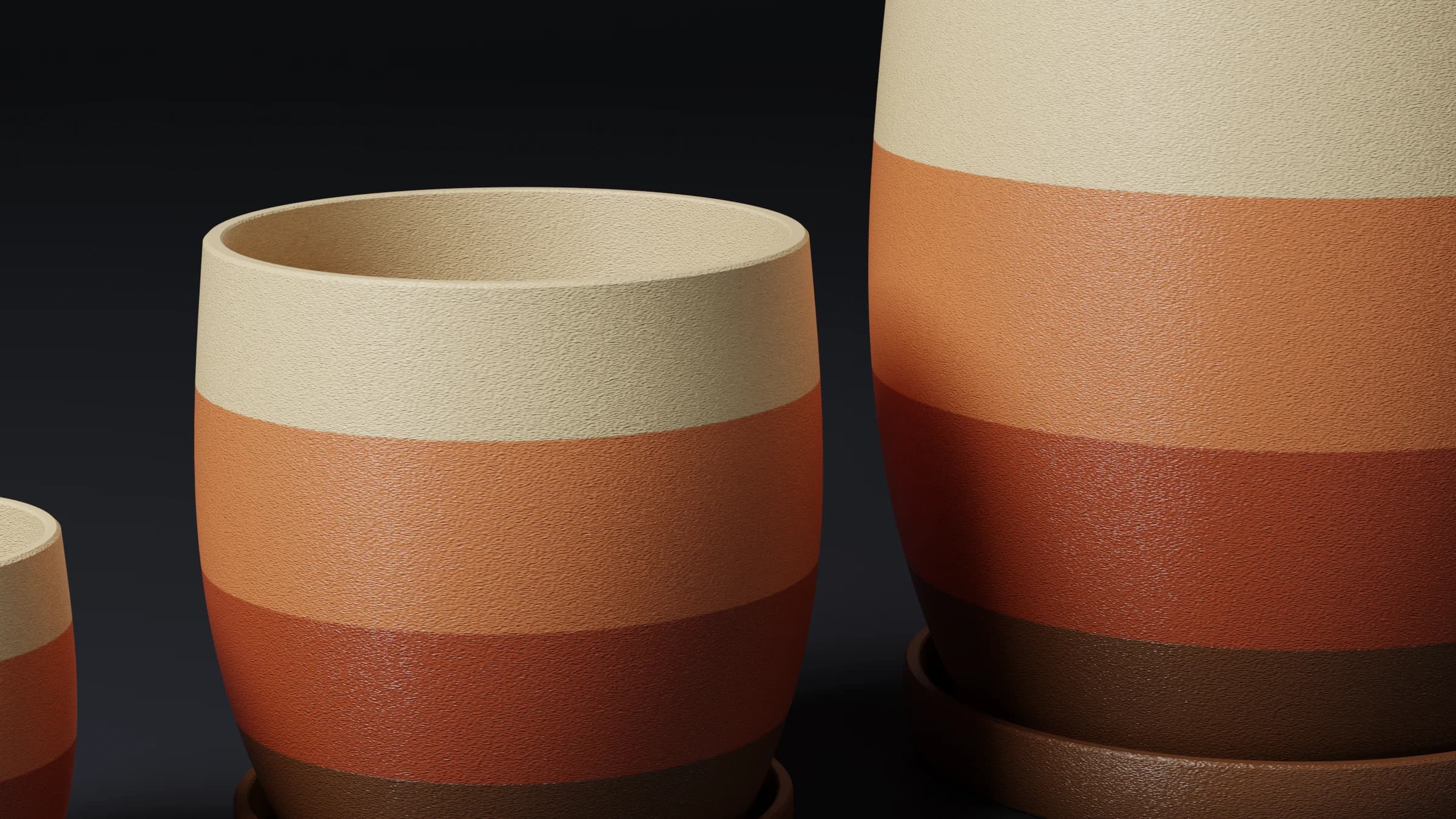
The materials side by side
Yannic Fréson 3D prints in PLA, PETG, ABS and ASA. PLA gives the cleanest surface and the most colours, but softens with heat. PETG is tougher and copes with moisture. ABS and ASA take the most heat: the manufacturer states 87 °C for ABS and 100 °C for ASA.
| Material | Appearance | Good at | Weak at | Typical for | Stock |
|---|---|---|---|---|---|
| Matte PLA | Matte, layers hardly show | Crisp detail, many colours, lowest price | Heat, sun, sustained load | Decoration, name signs, holders, indoor enclosures | 10 colours |
| Silk PLA | Silky sheen, almost metallic | A striking surface | Heat; the sheen shows every imperfection | Vases, ornaments, trophies | 1 colour |
| Wood-filled PLA | Matte and grainy, with real wood powder | A warm look; layers read as grain | Heat, moisture, fine detail | Lamp bases, interior pieces, gifts | 2 colours |
| PETG | Slightly glossy | Tough, copes with moisture and more heat than PLA | Less crisp detail, fine strings | Clips, knobs, parts in daily use | To order |
| ABS | Matte to satin | Heat (87 °C according to the manufacturer), knocks | Sunlight, shrinkage on large parts | Parts in a warm environment | To order |
| ASA | Matte to satin | Sun, rain and heat (100 °C according to the manufacturer) | Shrinkage on large parts, higher price | Anything that stays outdoors | To order |
The temperatures for ABS and ASA are the heat deflection temperatures (HDT at 0.45 MPa) that Bambu Lab states for its own filament on the Bambu ASA product page. They are the manufacturer's figures, measured on test bars, and not a guarantee for your part. A printed part with thin walls deforms sooner. For PLA and PETG no numbers are given here, on purpose.
PLA in three finishes
The same material, three characters. They can be combined in one object.
Matte PLA
The workhorse finish, in ten colours. The matte surface scatters the light, so the layers hardly show. Good for almost everything, which also makes it the dullest to write about.
Silk PLA
A silky sheen that leans towards metal, in stock in Titan Gray. Lovely on flowing shapes such as vases. The sheen is honest: every imperfection in the design gets lit up too.
Wood-filled PLA
PLA with real wood powder, in Black Walnut and Rosewood. The surface is matte and slightly grainy, and the layers read as grain. According to the manufacturer the shade can vary slightly from spool to spool.
PLA: the standard material
PLA is the standard material at Yannic Fréson 3D, for prints that stay indoors, have to look good and face no heat or heavy load. It gives a clean surface with crisp detail and is in stock in thirteen colours. PLA is not heat-resistant: in a car, a dishwasher or behind glass in the sun, a part can deform.
PLA stands for polylactic acid, a thermoplastic based on lactic acid. It is the most widely used filament in FDM printing because it melts at a low temperature and barely shrinks. For a print, what matters is this: PLA is stiff and dimensionally stable, it is the material in which fine detail and sharp colour boundaries come out best, and it is the cheapest filament in the rates. It is also rather brittle: it breaks before it bends.
It suits decorative and lightly functional prints indoors: name signs, keychains, planters, lamps, storage boxes, holders, scale models and enclosures for low-voltage electronics. Prototypes to judge shape and fit are usually printed in PLA too.
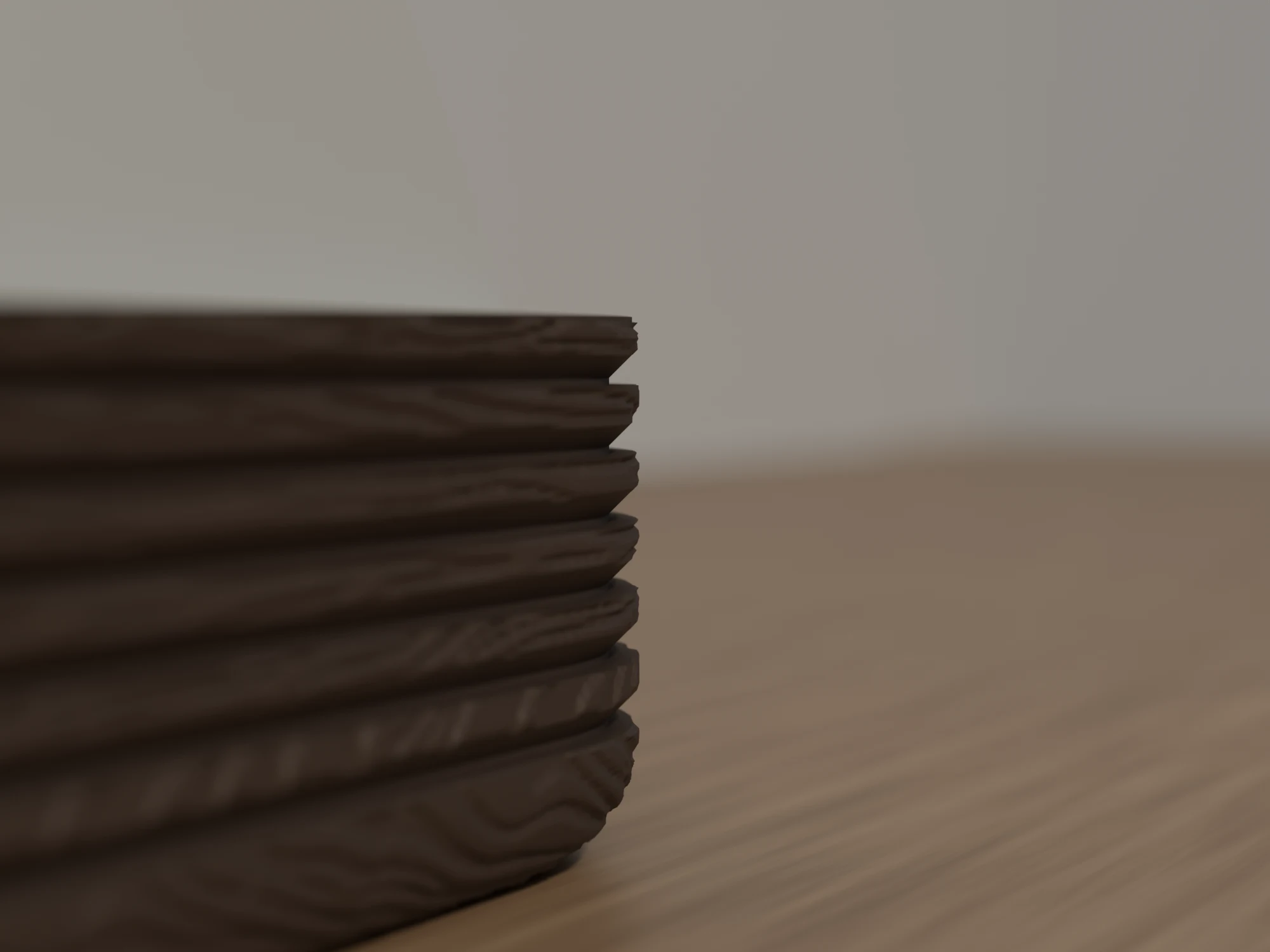
Wood-filled PLA remains a plastic that looks like wood: you cannot stain or plane it, and it is not suited to very fine detail. That the filament contains wood powder and that the colour can vary slightly per batch is stated on the Bambu Lab PLA Wood product page. Horizontal grooves or ribs in the design strengthen the wood effect, as on the base of the Valley Lamp.
PETG: for parts that have a job to do
Yannic Fréson 3D recommends PETG for parts that are used rather than looked at: replacement knobs, clips, cable guides, hooks, wall holders and enclosures for electronics. PETG is tough: a part bends before it breaks, which suits clips and snap fits. It copes with moisture and with more heat than PLA.
PETG is a variant of PET, the plastic of drinks bottles, with glycol added so that the material stays tough and prints well. Descending from bottle plastic does not make a print suitable for food: the layers hold residue and the filament has no food-contact certificate.
The price of that toughness is a less tidy surface, sometimes with fine strings, and less crisp detail. Layers and seams show more than on matte PLA. For a decorative piece with sharp areas of colour, PLA remains the better-looking choice. For years in full sun, ASA is the better one.
Bambu Lab recommends an enclosed printer for PETG, so that a cold room does not weaken the bond between layers. That is stated in the Bambu Lab filament guide. The P1S is such an enclosed printer. Two of the price examples are worked out in PETG: a replacement knob for an appliance and a batch of fifty clips.
ABS and ASA: for heat and for outdoors
Yannic Fréson 3D recommends ASA for parts that stay outdoors: caps and clips for garden furniture, wall holders, covers for a caravan, bicycle or motorcycle. ABS is for indoor parts that get warm, such as a holder in a car. According to the filament manufacturer, ASA has a heat deflection temperature of 100 °C and ABS of 87 °C.
ABS (acrylonitrile butadiene styrene) is the hard plastic of building bricks and car dashboards, among other things. ASA (acrylonitrile styrene acrylate) was developed as an alternative to ABS with better weather resistance: it withstands UV light, oxidation and ageing. In a print the two are much alike. The difference lies in what the sun does to them. The figures and the comparison come from the Bambu Lab ASA product page.
The downside is shrinkage. Large, flat parts can warp or split between the layers, so ABS and ASA mainly suit smaller, compact parts. Both need a warm print chamber, which the enclosed P1S provides. On the Bambu Lab ABS product page the manufacturer also warns about odour during printing. That stays with the printer: a finished part does not smell.
An enclosure in ABS or ASA is meant for low-voltage electronics. For mains voltage, for parts right up against a heating element and for anything somebody's safety depends on, nothing is printed, in any material. ABS and ASA have the highest rate per gram, which covers the filament itself and the greater risk of a failed print. If you have no heat and no sun, you do not need them and would only be paying more.
Which material to choose
At Yannic Fréson 3D the choice of material follows from three questions: does the part stay indoors or outdoors, does it get warm, and does it have to bend without breaking. Indoors and without load, PLA is enough. For parts in use, PETG is the first choice. For outdoors or for heat, it becomes ASA or ABS.
You do not have to make the choice yourself. Write in your request what the part is for and where it will end up; the recommended material is then in your quote. The most common mistake is choosing PLA for something that lives in a car. The second is choosing ASA for something that sits on a bookshelf.
The full comparison, with a table per property, is in the guide PLA vs PETG vs ABS/ASA: which material should you pick?.
What ordering on request means
PETG, ABS and ASA are not in stock at Yannic Fréson 3D. The filament is ordered as soon as you approve the quote, in the colour of your choice. The lead time of 3 to 5 working days can become longer as a result; the date your part will be ready is in the quote.
The advantage is that you are not tied to whatever happens to be on the shelf. The drawback is that a small part in an unusual colour has to wait for a spool. If you are in a hurry and the colour does not matter, say so: then the spool that arrives soonest is ordered.
The colours in stock
- Ivory White11100
- Charcoal11101
- Ash Gray11102
- Scarlet Red11200
- Terracotta11203
- Mandarin Orange11300
- Grass Green11500
- Latte Brown11800
- Dark Brown11801
- Dark Chocolate11802
- Black Walnut13107
- Rosewood13204
- Titan Gray13108
These thirteen colours of PLA are ready to go: ten matte, two wood-filled and one silk. Up to four can go into one object. Yellow and blue are not among them. Other colours, and every colour of PETG, ABS and ASA, are ordered on request.
What no material here does
Yannic Fréson 3D does not print resin, metal, SLS nylon or flexible materials such as TPU. None of the four plastics comes with a food-contact certificate, and no print is sold as a toy for young children or with a guaranteed load rating. The largest part in one piece is 256 × 256 × 256 mm.
- Food contact
- No certificate. Not suitable for contact with food.
- Children
- Prints are decorative or functional objects, not toys.
- Load
- No guarantee on the weight a part can carry.
- Flexible material
- No TPU or rubber-like filaments.
- Transparent
- No glass-clear parts; FDM layers scatter the light.
- Other technologies
- No resin, metal or SLS nylon.
Further reading
Don't know which material you need?
Describe what the part is for and where it will live. The recommended material is in your quote, with the reason.