What you can have printed
Yannic Fréson 3D, a 3D printing service for the Heist-op-den-Berg area in Belgium, prints your own file, designs a part to measure, recreates a broken one and supplies prototypes and small batches. Everything is printed with FDM, in PLA, PETG or ABS/ASA and in up to four colours. Orders are ready 3 to 5 working days after approval.
Four services
Each service has its own page with what you get, what it costs and what is not possible. Pick the one closest to your question.
Print your file
You have an STL, 3MF or STEP. Orientation and settings are chosen for you, then it is printed.
STL · 3MF · STEP
3D design on request
From a sketch, photo or measurements to a 3D model that can be printed. Billed per 15 minutes.
€60 per hour
Replacement parts
A broken or unobtainable part measured, redrawn and printed in a material that is up to the job.
PLA · PETG · ASA
Prototypes and small batches
A model you can hold, fit and show, and then dozens of identical parts without a mould. A fast prototype, unfinished and cheaper, is ready in 1 to 2 working days.
up to about 100 small parts
Which service fits your question
At Yannic Fréson 3D the choice depends on what you already have in your hands. With an STL, 3MF or STEP file, you want printing from your file. With a sketch, a photo or a broken part, the work starts with design, at €60 per hour. More than a handful of identical parts is a small batch.
You do not have to work that out yourself. Send what you have through the quote form and you get a quote for the right combination. Often it is two at once: first the drawing, then the printing.
If you are wondering whether the whole thing is worth the bother, the page with prices and worked examples shows what a keychain, an enclosure or a batch of clips costs. The smallest order is €10.
Printing in up to four colours
Yannic Fréson 3D prints objects in up to four colours, without paint or glue. The Bambu Lab P1S has one nozzle and an AMS unit that feeds it from four spools of filament; at each colour change the printer swaps filament and purges the nozzle. The colour is in the material, up to 256 × 256 × 256 mm.
Multi-colour printing is not a separate service here: it is an option on everything above. It suits logos, name signs, keychains and designs with blocks of colour. Nothing flakes off, because nothing was applied. A scratch shows the same colour as the surface.
Which colour goes where is fixed in the file beforehand. A 3MF file can store those colour areas. With an STL they are assigned from your example or your logo. Between two colours there is a line, not a gradient: the printer cannot mix. Four spools give four colours, not a fifth by combining them.
The colours are the fixed shades of the filament, so an exact brand colour, Pantone or RAL value is not possible. The closest shade is picked, and ordered if it is not in stock. The thirteen stocked colours are on the materials page. What each extra colour and colour change adds to the bill is in the rate card on the pricing page.
Cheaper ways to get colour
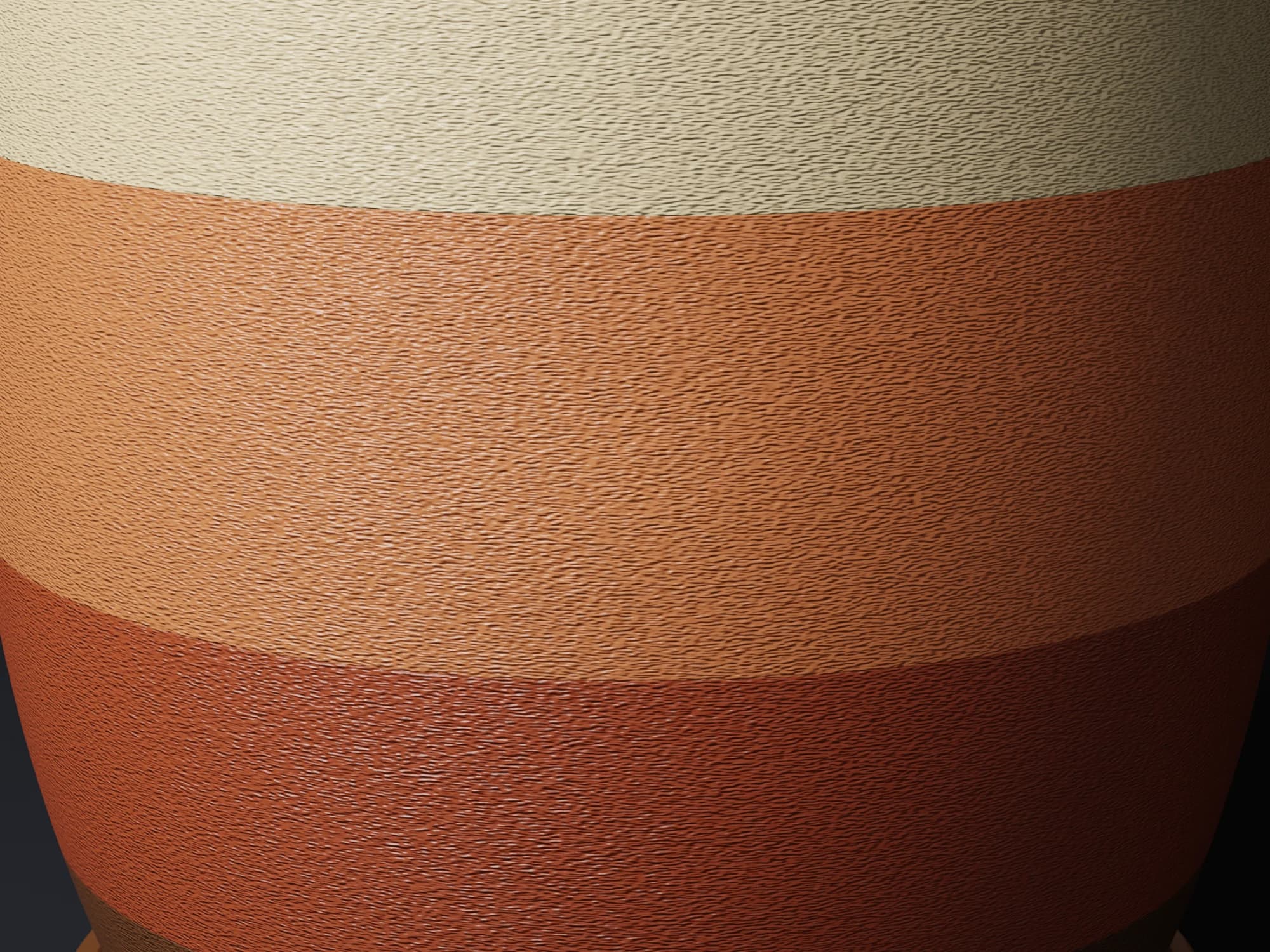
Yannic Fréson 3D offers three ways to put several colours into one print. A colour change per layer is the cheapest, because the printer swaps filament only a few times. Colour areas within the same layer give the most freedom and the most purge waste. Parts printed separately that slot together avoid colour changes altogether.
| Approach | Colour changes | Purge waste | Suited to |
|---|---|---|---|
| Colour change per layer | A few, one per band of colour | Almost none | Bands, and text or logos in relief on a flat plate |
| Colour areas within a layer | Up to several per layer | The most | Logos through the full height, patterns on a curved surface |
| Separate parts, each in its own colour | None | None | Inlays, lids, handles and parts you assemble |
Which approach fits best depends on the design. Sometimes the answer is a combination: a plate with a colour change per layer and a separate handle in a fourth colour. The Strata Planter in the image above changes colour per band, which is the cheapest way to get colour into an object and often the best-looking. See the Strata Planter in the portfolio.
What comes with every order
A look at printability
Before the quote your file is looked at for printability. You remain responsible for the dimensions and the function of your design.
A fixed price
Your quote states the price, the material and the date. Nothing is printed before you agree, and nothing is added afterwards.
Finishing by hand
Supports come off and edges are checked. The layers stay visible: that is in the nature of the technique, and up close it is rather handsome.
What is not on offer
Yannic Fréson 3D prints plastics with FDM technology only. Resin, metal, SLS nylon and 3D scanning are not on offer. Objects for contact with food, toys for young children, weapon parts and safety-critical parts are not made either. The largest part in one piece is 256 × 256 × 256 mm, printed with a 0.4 mm nozzle.
- Technology
- FDM only. No resin, no metal, no SLS powder.
- Scanning
- No 3D scanner. A part is measured by hand and redrawn.
- Food
- No cups, cookie cutters or other kitchenware that touches food.
- Toys
- No toys for young children.
- Safety
- No weapon parts and no parts that somebody's safety depends on.
- Size
- Up to 256 × 256 × 256 mm in one piece. Anything larger is printed in sections.
- Colours
- No more than four per print, and no gradients. Colours change; they do not mix.
- Detail
- Limited by the 0.4 mm nozzle. Thin lines and small text need to be drawn a little bolder.
Worth knowing before you ask
- 3D printing pricesRates, eight worked examples and the shipping costs.
- Compare the materialsPLA, PETG and ABS/ASA side by side, with the colours in stock.
- The printer and its limitsBuild volume, layer height, nozzle and what the machine cannot do.
- Where delivery and shipping applyDelivery to your door in the Heist-op-den-Berg area; shipping to Mechelen, Leuven, Antwerp and beyond.
Not sure which service you need?
Send your file, a photo or a sketch. You get a quote with a fixed price, the recommended material and the date it will be ready.